


 Contact
Informations
Contact
Informations Call Now
 Whatsapp
 Tr
Tr

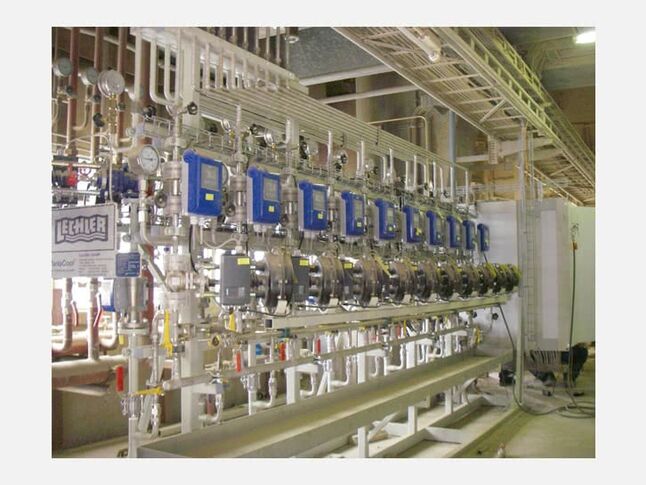
Denitrification solution that grows with requirements. Lechler joined forces with STEAG to develop an SNCR concept that reliably ensures compliance with valid limit values. Depending on the requirements of the legal situation, the VarioClean – heSNCR modular system can be flexibly upgraded.
VarioClean – heSNCR denitrification system
Denitrification solution that increases requirements. Requirements for reducing NOx emissions have increased significantly in many countries in recent years. Meanwhile, cement producers need to decide how to comply with existing emissions limits as primary measures are no longer sufficient. To this end, Lechler, in collaboration with STEAG Energy Services GmbH, has developed an advanced, highly efficient SNCR concept for cement plants that reliably complies with the relevant applicable limits: VarioClean with "highly efficient SNCR (heSNCR)".
The STEAG/Lechlerin high efficiency system is based on many years of experience with advanced SNCR systems in cement plants. We have more than 10 references in Germany that meet very stringent requirements such as NOx reduction of over 85% with maximum NH3 shift. 30 mg/ Nm3 . Additionally, we have many references around the world with our installations in China, where 100 mg/Nm3 limits can be reached.
Depending on individual requirements and the legal situation on site, the modular design of VarioClean – heSNCR can be flexibly adapted. Regardless of the number of nozzles selected, the base frame, input module and control cabinet always have the same design. The identically configured injection modules each feed two lances. The required injection modules are applied depending on the selected number of nozzles. Thanks to the modular design, further injection modules of up to 10 nozzles can be added later if the limit values need to be changed in the future. The amount of reagent is controlled separately for each injection module. This ensures that the right amount of reductant is injected at the right time and in the right place. For optimal distribution and injection of the reagent, Lechler Laval nozzle nozzles are used to accelerate the two-phase mixture to supersonic speed to ensure optimum penetration into the gas stream and optimum droplet size.
Our VarioClean – heSNCR system reliably meets current limits while minimizing reagent consumption and is also prepared for the future.
Due to the distance between the injection nozzles and the emission measurement point, there is a dead time of several minutes between the application of the reagent and its visible effects. In addition, different operating states of the cement kiln lead to different distributions of the resulting nitrogen oxides. A traditional PID control can only react to changes in emissions after dead time; It is not at all appropriate to take different NOx distributions into account. Modern Advanced Process Control (APC) modules offer superior control solutions here. Based on relevant operating data of the cement plant over a period of at least four weeks, predictive models are developed to estimate the NOx load and the required amount of ammonia to be delivered (feed-forward control). In the next step (research phase), the control system continuously changes the distribution of the reductant over the various injection points in order to identify the spears that currently work best. As a result, the system automatically adapts to the current operating conditions to reliably meet the specified limits with minimal ammonia water consumption.
Main benefits of STEAG/Lechler heSNCR
- Strict compliance with NOx and NH3 emission limits
- Low operating and maintenance costs
- Practically maintenance-free
- Fully automatic control modules using APC
- Intelligent setpoint control
- Adaptive NOx prognosis
- Injection of optimum amount of ammonia-water
- Optimum ammonia-water distribution thanks to the adaptive Lance Select module (ALS)
- Checking the operability of the lance
- No additional ATEX requirements as the valve slides are completely durable and tight
- Pumps with frequency converters to ensure constant outlet pressure and therefore reduced throttling ratios of control valves
- Each pair of spears can be cleaned and maintained individually while the SNCR process is in progress
- Individual flow detection of spears for online detection of blockage in spears (part of the STEAG Monitoring System)


